Two analogies for understanding the non-linear nature of strategic thinking
People often try to force strategy into linear plans, process, and artifacts because they desire concreteness and simplicity. That forcing seldom leads to good strategy.
These two analogies offer promise as ways to help you learn to be a better strategic thinker. They will help you grasp the essential complexity and ambiguity that is inherent to strategic thinking.
The Rhizome Analogy
A few summers ago I spent many hours removing pretty-leafed invasive ivy from a flowerbed. I would dig out a shovelful of earth and carefully pick out any trace of its root system, because a small segment of root would re-sprout. Botanists call this kind of root system a called rhizome. Rhizomes are characterized by root systems that explore, connect and reconnect, and establish new shoots.
The analogy of a rhizome is relevant to learning and practicing strategic thinking. The similarities include:
- It is about making connections. With a holistic point of view, you can make the case that there is a multiplicity: everything is connected to everything. Similarly, every person is connected to every person. What would happen if we connected a group of competent strategic thinkers?
- It is distributed. You can start your discovery anywhere. You can follow the thread, and end up knowing more. Yet, there will always be individuals who have a different and deeper knowledge, simply because they’ve spend more time on a different path.
- A “rupture” line will emerge with a new shoot. If you make a digression or get interrupted, you will probably follow a different direction for your line of thought. Strategic thinking is inherently non-linear just like a rhizome. You can travel along a segment of a rhizome (such as reading a story) but inevitably some interesting point or curiosity or connection will take you in a different direction.
The rhizome analogy fits the non-linear nature of strategic thinking. Instead of an idealized and rational body of knowledge, it is better to see it as a subjective, growing, recursive, tangled, and sprouting structure. The following graphic should help you visualize the strategic thinking rhizome.

The Nomad Analogy
This metaphor refers to the individuals and small groups who are constantly moving. Indeed, walk through any airport or coffee shop and you’ll see hundreds of people learning and contributing to work. Nomads are constantly alert to opportunity, improvising and adapting current resources. The nomadic lifestyle is one of curiosity, networking, and sharing.
A nomad has a basic task of accomplishing work. They seek resources, knowledge when and where they can find it and rely on others.
Three Lessons
Here are three lessons that will help you be better at non-linear learning and contribute to your proficiency as a strategic thinker:
- Pick and follow a thread for a while. See each little chunk of knowledge as something that connects to others. Don’t worry about complete, logical structures. Things will make sense, little by little.
- Look for connections. Be ready to see the points of intersection, overlaps, convergences, and new sprouts of insight. Strive to incorporate abstract principles, models, and definitions with your own experience. Be alert for opportunities. Don’t worry about strategic thinking being a tangled mess.
- Be an active learner. Take responsibility for your own learning. Ask questions. Don’t assume there is a nearby expert, nor that expert is correct.
References and Resources:
Deleuze, Gilles and Guattari, Félix. (2002). A Thousand Plateaus Capitalism and Schizophrenia. London: Continuum.
https://davecormier.pressbooks.com/chapter/learning-in-a-time-of-abundance/
Rhizomatic and nomadic learning are relevant to building competence in strategic thinking. Do you agree?

 Today’s business consultants, strategic planners, trend-spotters, and management experts sell predictions. They are satisfying a market need. But it’s not likely they are enhancing anyone’s strategic thinking.
 The nearby figure illustrates the phase space for a complex system. Notice that there is a circular disc on one plane and it appears that the system is mostly in that region, However, is another disc arcing upward. Is that an emerging new shape? Complexity theorists tell us that system is converge towards a particular area of phase space, called a “strange attractor.”
 We can take a lesson from Christopher Columbus’ practice of recording notes, observations, and ideas in a personal journal. Biographer Eugene Lyons closely studied Columbus’ journals, concluding that,
 .
.
 Forecasting and backcasting are common techniques for understanding the future. They have specific meanings. Forecasting is an extrapolation of current data into the future. When I identify a trend, I can choose to forecast that trend to continue. Back casting is the selection of a future scenario and then identifying the variables that would be needed to bring about that future scenario. An example: I wonder if a presently-strong company will fail in the future; I identify the premises and arguments that explain what would cause that failure.
 All students of strategic thinking occasionally feel just a little lost and frustrated. I imagine the topic of strategic thinking as a map – albeit a fuzzy and dynamic map – with salient landmarks that help you navigate through the subject. Even with the best of maps, you can find yourself wandering about when you’re in the field for the first time. Fortunately, with experience, the landmarks seem familiar and expected. The exploration seems more natural.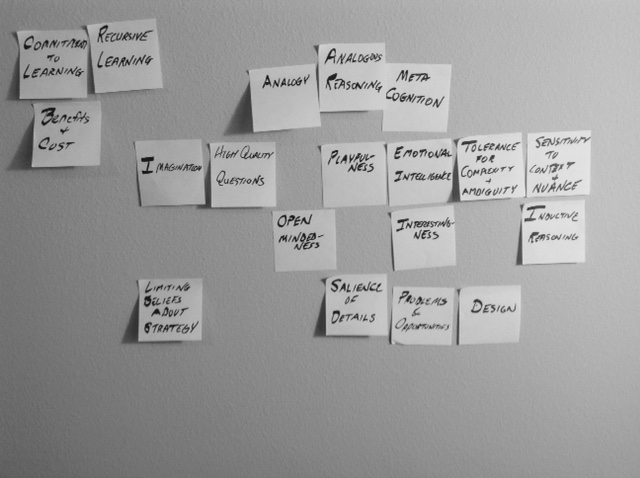


 Greg Githens, Executive & Leadership Coach