Absolut Vodka’s Search for Strategic Insights: Lessons for the Strategic Thinker

Lessons for Strategic ThinkersHere is a problem statement.  This article explores its resolution, applying the perspective of a strategic thinker and developing lessons applicable for other situations.

Absolut Vodka is a go-to name for ordering cocktails at the bar. But when it comes to entertaining at home, beer, wine, and other spirits are also top of mind. However, celebrations are increasingly happening in personal places – houses, apartments, rooftops, and backyards – especially in the summer. So we wanted to get people thinking of Absolut for all their house party needs.

This was the situation faced by Pernod Rickard USA, the US distributor of Absolut Vodka. Do people buy liquor for home parties because of the quality of the liquor, or for something else? What insights could be useful in constructing a strategy to effectively penetrate home-party market segment.  These are the kinds of questions that can’t be determined in data mining and “hard data” analytics.

Absolut Vodka’s Search for Insight & Strategy

To get answers to these fundamental questions, Absolut paid a research company (ReD) to apply its expertise in ethnography. ReD dispatched a team to several locations, including Min Lieskovsky who allows Graeme Wood of the Atlantic magazine to shadow her at a home party in Austin, Texas (see his article titled “Ethnography Inc.” in the March 2013 issue). She spent the evening carefully observing people, especially when it came to activities involving alcoholic beverages. Lieskovsky would watch carefully as guess arrived, greeted the hostess, and interacted with other guests. She would note what happened at each step and note the patterns (which became essential to the strategy).

The academic discipline of ethnography is associated with anthropology, and involves careful observation of native cultures.  Now being increasingly applied to business contexts, ethnographers carefully observe people (in this case, the behaviors of party goers) and objects they interact with (liquor). In this case, the researchers were searching for patterns in “the rules and rituals – spoken and unspoken –that govern Americans’ drinking lives, and by extension their vodka buying habits.”

Pattern Searching

In analyzing observations from 18 home parties in Columbus, New York and Austin, Lieskovsky and her colleagues noticed a common pattern in the giving of liquor to the hostess:

“They told anecdotes about their own lives in which the product played a central role – humorous self-depreciating stories about first encountering a vodka, or discovering a liqueur while traveling in Costa Rica or Mexico.”

The anecdotes had to do with humor and adventure. The chemistry of the liquor (Absolut’s branding premise for beverages sold in bars), was of little importance. We’ll see how this pattern was valuable momentarily, but first we need to quickly review the role of sense making in the generation of strategic insights.

Sense Making & the Generation of Strategic Insights

Sense-making is the ability to interpret patterns, where the interpretation forms a story that is relevant to the stakeholder. When we make sense of things, we take the data and look for connections. The result is the ability to gain alignment and commitment in areas that have complexity, ambiguity, or high uncertainty.

Tip: it is often useful to say to yourself, “What is interesting about this?” In this case, gifts were not about alcoholic purity.  The gift had deeper meaning revealed something about the story teller’s identity and functioned to make the giver and giftee more intimately connected as people.

Wrapping your product in story is the insight for the product developers. It is an opportunity to develop a marketing brand strategy. Maxime Kouchnir, VP of Vodka Marketing of Absolut’s distributor said, “At the end of the day, we manufacture a spirit, but we have to sell an experience.”

The core insight for marketing Absolut at home parties is to recognize the importance of conviviality and humor. People desire to be conversational and witty.

A Focused Strategy for Home Parties

Good strategies are coherent and focused. Here we have a defined market segment, and we now understand something about the motivations of the consumer.  We need to exploit it.

Given the trends for mobile computing, it was natural to develop a mobile application for home party planning. The party planner now has a tool for selecting a clever party theme. Then there are ideas for sparking conversation and wittiness. In Big Spaceship’s explanation, they said, “rather than simply telling people that Absolut is perfect for parties at home, we decided to help them host one. By creating a useful party generating tool we were able to communicate the brand’s message and give people something valuable to use.”  In the design of the app, you can draw a direct connection back to the themes found in the research of the ethnographers.

Strategic Thinkers “Go Native”

Now let’s step back.  One important learning from this example is that the strategic thinker can gain sights from “going native,” that is going into the field and directly observing the consumer experience.

Obviously, this immersion into the world of the customer takes time. So if you don’t personally think your time is better spent elsewhere, you can still practice strategic thinking by considering questions that need to be asked.  Try to step outside the normal frame to discover the crux of the matter.

Another lesson is that it’s not always about hard data. Qualitative data and observation is often the source of powerful strategic insights. Insights come from using empathy and probing for deeper meanings.  Often customers see the product entirely differently than does the product developer.

Finally, stay alert for patterns, look for interesting things, and strive to make sense of complexity. Insights will result.

How have you developed a deeper empathy for a business problem?

A Lesson on Recognizing and Applying Strategic Insights || 3M’s Post It Notes as an Example || Thinking Strategically

recognizing and applying strategic insightsIn the article How Strategists Produce Strategic Insights, I introduced the concept of insights, defining them as a person’s realization of “the true nature of a thing” and/or its relationship to some contextual factor. The following example of the development of 3M’s Post It notes shows that it’s a valid definition. I found six strategic insights.

Insight #1 – A Strategic Thinker Recognizes Interesting Functional and Physical Properties

In 1968, 3M research scientist Dr. Spence Silver first developed the technology was working on an assigned project to improve the acrylate adhesives that 3M uses in many of its tapes. In a classic case of innovative serendipity, Silver found something quite remarkably different from what he was originally looking for. It was an adhesive that formed itself into tiny spheres with a diameter of a paper fiber. The spheres would not dissolve, could not be melted and were very sticky individually. But because they made only intermittent contact, they did not stick very strongly when coated onto tape backings.

Silver knew that he had a highly unusual new adhesive. Now the challenge was: How to find a commercial opportunity? For the next five years, Silver gave seminars and approached individual 3Mers, extolling the potential of this new adhesive and showing samples of it in spray-can form and as a bulletin board.

Insight #2 – A New Product Needs a User Who Will Find Utility

Art Fry a product developer at 3M was frustrated at how his scrap paper bookmarks kept falling out of his church choir hymnal. Fry’s insight was that using “Silver’s adhesive could make for a reliable bookmark.” This was the first practical application of what we now know as Post It notes.

Fry extended the bookmarking insight and realized that there was a broader application. In a BBC interview recounting the insight, Fry slaps his forehead with his palm and exclaims, “What we have here is not just a bookmark. It’s a whole new way to communicate.”

Insight #3 – Find New Ways to Gauge Market Potential for New, Unfamiliar Products  

Market research is difficult with really new products. Four test marketing experiments in different cities in 1978 had proven disappointing. Few people wanted to pay for a product when they could use cost-free scrap paper. Two 3M executives became personally involved in a test in Richmond, Virginia and achieved as useful insight when they experimented with giving away samples to fellow executives.  People liked them and wanted more!

The next trial was a marketing demonstration called the Boise Blitz, because of its intensity. It scored a 90 % reorder rate from free samples, twice what 3M had seen with any other office product.

With the results of the Boise Blitz, 3M knew that a market existed.  It could now commit to the time and cost of engineering and manufacturing the product on a commercial scale, which it accomplished in 1980.

Insight #4 – Exploit Your Core Competencies for Strategic Advantage  

There were many engineering challenges to solve with this brand-new product. One was the paradoxical challenge of getting a weak adhesive to adhere to the paper.  A second challenge was designing machines and manufacturing processes.

All US production was centered in a manufacturing facility near Louisville, Kentucky. There, 3M could apply its core competencies in engineering and manufacturing. 3M’s ability to design a robust, qualified, efficient manufacturing process was the key to the profitability of the product. An engineer who had worked at the Kentucky facility for years told me that they would joke that the Post-It manufacturing process was so lucrative that they were really just printing money.

It takes insight to recognize and match core competencies to engineering and production challenges.

Insight #5 – Extend Your Advantages (Product Family Line)

The “genius” of the technology is in the adhesive and its binding to the paper.  Now, with just a little imagination you can create an entire product line.

Insight #6 – Persistence and Ambition Are Components of Strategy

The story of Post-Its makes for a great narrative and it illustrates the formation of a strategy of opportunistically combining insights.  Yet, the product would have gone nowhere without the of the people involved.

  • It took twelve years from the time that Silver developed the adhesive until the product was launched.  At times, both Silver and Fry were working on the development “off budget.”
  • The company kept at the market research, too, not being discouraged by the poor results. Executives championed the somewhat-risky idea of giving the product away and watching for insight in the results.

As I look at the relationship of strategic thinking to strategy in this and other examples, I come to the conclusion that strategy is assembled out of insights and other things. Those other  things must include the  persistence and ambitions of individuals, which is the quality of strong mindedness. (Watch for a future article.)

Conclusion

I introduced this article by characterizing strategic insights. I wrote that they are a person’s realization of “the true nature of a thing” and/or its relationship to some contextual factor. In the above, I mentioned two individuals – Silver and Fry – who had realized something that seemed relevant and important.  The insights had to do with the contextual factors of materials, users, markets, competencies, and personal values. There are other contextual factors present in the case; however, it seemed a bit of an overkill to discuss them. They include: opportunities, viewpoints of the past/present/future, competitor behavior, macroeconomics, and 3M’s historical narrative from its founding to the time of the case.

Individuals acquire insights through conscious analysis mixed with unconscious (intuitive) cognition. The first example of this is Fry’s conscious effort to apply the adhesive to scrap paper for marking hymnals, combined with the realization that “this is a new way to communicate.” A second example was the market research that mixed formal analysis of demand with a leap-of-faith demonstration: Here are free samples. Use them and let us know when you want more.

Note that activities that involve trial and error often generate insights. Indeed, the very discovery of the adhesive was a result of experimentation and serendipity. Fry developed and tested a hypothesis: “Would this adhesive-coated scrap paper function effectively as a place holder in a hymnal?”  The initial attempts at market research did not signal potential, but a breakthrough insight came with the response to free samples in Richmond and its confirmation with the Boise Blitz.

Does the story of 3Ms Post Its provide you with a better understanding and appreciation of the value of strategic insights?  Would you like to learn more about how to generate, recognize, and organize them?

How to Improve Your Ability to Imagine the Future

how to improve your ability to imagine the futureStrategic thinking is a style of thinking that – among other things – is concerned about the future.  When done well, we could say that strategic thinking makes a person more “futures ready;” that is, having an attitude that is comfortable with change, anticipates change, and proactive with responses. Unfortunately, this futures-ready stance is not common. However, we can train people to be more futures ready. This article provides an approach that starts with the individual.

A Thought Experiment

Try out this exercise. Imagine yourself 15 years ago. The year is 1998.  Consider these questions:

  • In 1998 mobile phones were gaining widespread use. Could you have imagined how they would have taken over functions like time keeping, photography, and gaming?  Could you have imagined laws being promulgated to restrict texting while driving?
  • In 1998, would you have imagined that any of your friends or family would have died “before their time?” I can say – based on my own experience with a death of someone close to me – that it makes a lasting impression and causes a re-thinking of priorities.
  • In 1998, most babies in the US were born to parents married to each other.  Today, more are born to single women than to married parents. Would you have predicted that?
  • In 1998, could you have imagined these two economic slowdowns: the “dot com bust” and the “Great Recession?”
  • In 1998, would you have imagined a terrorist attack on US soil that would have changed the structure of government, airport security, and entry into sporting events? The scope and far-ranging impact of the 9/11 attacks has created all kinds of change to the daily life of Americans and others.

I have conducted the above thought experiment with many people, and note this pattern: the person realizes that the amount of change has been astounding.  One person called their experience with change, “jaw dropping.” These memories and reminiscences can be quite strong and stimulate some interesting conversations; but, the point is to get them to shift their thinking towards the future.

Now, some readers would answer the thought experiment with this response, “Sure, I could have imagined this.”  However, you probably didn’t. You were probably concerned with the joys and problems of your life at that moment in time. You were (and are) probably like most people: you the present time is your reality. It is concrete, whereas the future is an abstraction that gets little of your attention.

After looking 15 years into the past, I next ask them to imagine 15 years into the future. If I want to really stimulate their imagination (or aggravate them), I ask them to imagine as much “jaw dropping change” for the future as they recall for the past. This is difficult, and requires encouragement.

Most people think tomorrow will be more of today. They develop views of the future that linear extrapolations of the current condition.

Let’s put the 15-year span into perspective. Home mortgages are typically 15 or 30 years.  Some people own their cars for 15 years and are even wearing the same suits and shoes. Fifteen years is the lifespan of a family dog. Those examples show us that 15 is an understandable span of time.

One common pattern is that people — looking back in time –often refer to the passage of time as a “blink” or “time flies.” However, when looking into the future, people tend to discount how fast it will arrive.  This asymmetry tells us that it is tough to be “futures ready.”

Envisioning the Future – Start With Some Easy Questions

The following questions are about the future, and have answers that require only a bit of arithmetic and imagination. Write down your answers to these questions.

  1. What is your age in the year 2028?  Imagine your parents or grandparents at that age and their physical and mental health? How old will your children be?
  2. How many years has your organization (employer) been in business in 2028?

Expand your answers with some written words or images. Linger on this description, engaging your intuition; does it feel right? Then try to look at that future with a different perspective and consider other questions that might help you with envisioning.

Trends – Useful but Remember the Wildcard Scenario

Invariably, the discussion of the future brings in trends and forecasting, so go ahead and make note of the them. The typical list includes: climate change, wearable technology, population growth, nations that we now consider developing are fully developed, more weapons (international and domestic), and more globally-interconnected communications.

Futurists recommend that any futures-ready view include a “wild card scenario.”  Consult the above thought experiment placing you in the year 1998: terrorist attacks and the Great Recession might qualify as wildcards: extraordinary events that might be difficult to anticipate but have far-ranging effects.  Here are a two ideas for wildcards that could disrupt life as we now know it: pandemics and a large meteor strike.

Delight and Disaster Scenarios

Here is one more exercise for your imagination. Imagine two futures. One is optimistic and wonderful. It is the ideal world.  The second scenario is one that is more pessimistic.  Explore what that scenario is like for you personality, your organization, and your network of friends, family, and social organizations. Emphasize the impact of the scenario, rather than the probability of occurrence.

Recognize How Status Quo Becomes a  Barrier

Earlier I noted that people don’t do as well with future imaginings compared to past rememberings.

One reason is that  people tend to remember things that are recent, concrete, and salient. This is often referred to as the  anchoring bias.  A second reason is that the future is ambiguous and people tend to be ambiguity avoiders. People prefer to think and talk about things that they have evidence for, and avoid things that don’t.

What is most real? The present. This shows up as status quo thinking. Recognize it as a barrier, and apply both imagination and analysis to developing a view of the future.

Expanding the Future

These thought experiments add value to your strategic thinking because they place patterns and ideas into your memory. Your subconscious  works with these concepts by recognizing patterns and producing insights.

What other ideas do you have for helping individuals become more “futures ready?”

Action Without Thought is Impulsiveness, Thought Without Action is Procrastination

Action with thought is impulsiveness thought without action is procrastination - Greg Githens

Impulsiveness is “the trait of acting suddenly on impulse without reflection.” Impulses are often described as “whims, sudden involuntary inclinations, unpremeditated, and instinctual urges.” Impulsiveness is good in some situations: an almost child-like quality marked by spontaneity, playfulness, and humor.

On the other hand, impulsiveness may be nothing more than bad habit and selfishness. When impulsiveness is unwanted, the message seems to be this:

think – that is, reflect at a deeper level – before acting.

The opposite of strategic thinking might be mindlessness. The characteristics of mindless thinking are little concern with outcomes, present focused, focus on concrete elements of the task, little imagination, little courage, lost in details, and unconcerned with opportunities.  When scientists want to study people with high degrees of impulsivity, they research inmates in prisons!

Procrastination is a habit of delaying action on something that is important. It is often habitual and arises from analysis paralysis, lazy thinking, fear, or unclear values. Procrastinators should take action, but don’t.

Procrastination is not an intentional delay to minimize the probability of loss.  As psychologist Piers Steel (author of the The Procrastination Equation) points out, procrastination is an irrational delay. Thus, procrastination is not strategic in the sense of avoiding threats or capturing opportunities.

Both Impulsiveness and Procrastination Are Disengaged Thinking

The extraordinary availability of gadgetry – smartphones and the like – seems rule people’s life: stories emerge of people checking for updates in the most inappropriate of places or times: church, job interviews, seminars, driving, and even sex!

Gadgetry and impulsiveness seem to go together. People need to think through the consequences.  Impulsive use of gadgetry is also procrastination, in that it defers action something important that you know you should be doing (developing a spiritual life, showing a basic courtesy to an interviewer, paying attention to new learnings, being a safe driver, being intimate).

People who thinking strategically focus on that which is important to their success. They know that there are more and less important things in life, and they need to make choices about when to be bold and when to be cautious.

To Think Strategically is to Balance Thought and Action

Both impulsiveness and procrastination seem to be in tension with each other. That means that each is a polarity to manage, and the key in any polarity is to manage a balance. How?  First, I try to monitor and manage my attention so that I don’t spend too much time in thought, and to catch myself when I am impulsively plunging into action.  Even better, I trying to both “think and do” simultaneously; with practice, it is not too hard.  Also, I find perspective in F. Scott Fitzgerald’s quote:

The test of a first-rate intelligence is the ability to hold two opposed ideas in the mind at the same time, and still retain the ability to function.

Second, I keep in mind the idea that mistakes can easily be made (by me and by others). I constantly try to be alert for mistakes, and I have internalized that into a technique that I call The Compact Approach to Strategy.

The third thing I do is related to mistake avoidance: I maintain the vision or working definition of success for myself or the endeavor at hand. Strategic thinking is not the same as creative thinking; creative thinking is concerned with cleverness and strategic thinking is concerned with strategy and success.

Fourth, I recall experiences in agile product development organizations, where they divide work into discrete chunks, and use experimentation and prototyping.  This iterative approach gives us useful information that allows them to rapidly move towards workable ideas.  They are not concerned with the perfection; they are concerned with workable ideas that serve as small wins for betterment.

Are You “Lost in the Weeds?”

I frequently am asked a question by people who know they should be strategic, but are trapped by habit into a comfort zone of technical activities. They ask, “How do I keep myself from being lost in the weeds?”

My reply is that they first should congratulate themselves, because they are recognizing they have a problem that is limiting their effectiveness. This is not unlike addiction recovery programs; the first step is to “admit that you have a problem” and understand how this problem is affecting yourself and others.  (Admittedly, the problem of “being tactical” rather than strategic may not equate to the misery of drug addiction, but it still affects your life in that you may be missing opportunities that could lead to your success.)

“Being tactical rather than strategic” is a form of procrastination.

Regardless, being “lost in the weeds” is both a habit of spending too much time in your comfort  zone (rather than your learning zone). As basic as it may be, the advice is simple: raise up your head (pay attention) and look around (at the strategic context).

Competent strategic thinkers manage their attention, and are aware of the balance between contemplation and action. As you get more comfortable with this balance, you will find that thought and action are more similar than they are different.

How does the idea that “action without thought is impulsiveness and thought without action is procrastination” apply to your goal to be a better strategic thinker?

How Strategists Produce Strategic Insights

how strategist produce strategic insights

In my book, How to Think Strategically, I describe a map of strategic thinking. One of the most important landmarks on that map is insight. When you want to assure that you are thinking strategically, remember this:

The purpose of strategic thinking is to produce insights

 Insight is,

A person’s realization of “the true nature of a thing” and/or its relationship to some contextual factor.

 Examples of Strategic Insights

The discovery and application of  insights is central to strategyThe process of thinking strategically is purposeful in that the strategist intends to create advantage in the future. A few examples of strategic business insights are:

  • A marketeer’s realization that a customer need is not being met adequately by existing products or functions
  • An employee’s realization that an impending piece of regulation or legislation will fundamentally alter the industry.
  • An auditor’s realization that a pattern of transactions show fraud
  • An engineer’s realization that they have created a novel invention

Strategic insights are those insights that are useful for developing organizational strategy.

Three Kinds of Insights Needed for Business Strategy

In the context of organizational strategy, the strategist is searching for three kinds of insight. They are:

  • Insights about the current situation. What are the problems and opportunities?  What are stakeholder aspirations and motivations?
  • Insights about the future. What will be different, and what is preferred? Since choice of customers tends to be one of the most strategic decisions, what customers might be best to serve?
  • Insights about how to bridge the gap between present and future. These insights involve problem solving: taking into account a full range of constraints: competitive response, political will, resources, and organization.

Insights are a Neurological Flash

Research into the functions of the brain reveal  the right hemisphere a region (more specifically in the right hippocampus) is the location responsible for  insights involving verbal information. As neuroscientists continue mapping the brain, we are sure to get a better understanding of those mechanisms responsible for the practice of thinking strategically.

How to Generate Insights: Balance Thinking Hard with Detachment

Individuals have their own style of doing things. Research has not shown one best practice for generating insights. Rather than give you a cookbook, let me encourage you to apply some energy to each of these five activities.  Be patient, and insights will emerge!

  • Preparation – identifying issues, collecting and categorizing information, assembling resources
  • Analysis – actively looking for relationships and patterns in data. Continually asking questions and reframing to find new perspectives. Searching for what is interesting. Validation and hypothesis testing.
  • Detachment – Getting away from the issues and allowing the subconscious to work on the issues.
  • Articulation – Explaining the crux of the situation to others. Trial and error solutions.
  • Refinement and iteration – Returning to earlier activities.

Strategic Insights Are Those That Are Relevant and Meaningful

I earlier defined insight as  a person’s realization of “the true nature of a thing” and/or its relationship to some contextual factor.   I close out this article with exploring the final part of the definition, the “relationship to some contextual factor.”

When people hear the word “insight” they typically assume that it must be a brilliant new observation: an epiphany.  However, I find that kind of “aha” to be rare. Instead of brilliance, I keep it simple by testing it with this criteria of relevance and meaningfulness. Here’s a useful question:

Is the insight relevant and meaningful?

A relevant insight is one that is connected to current situation, future, and the bridge between the two (these were mentioned earlier in this article). Ideally, this creates some sense of alignment.

A meaningful insight is one that makes sense in a narrative. Here, I imagine myself in the future explaining how I created a successful strategy. If find that as I grapple with expressing the insight, I get a better sense of its worth and its motivational power.

Finally, a “contextual factor” is something that is external to the organization.  Examples include technological change, the economy, a social trend, etc. For example, Absolute Vodka had data that its products were purchased for drinking at home parties. But, why? It turns out that many people buy a particular brand of spirits because that they connect it to a personal anecdote; telling that anecdote to others is a way to be humorous or to relate an adventure. This insight gives the company a foundation for creating marketing and product development strategies.

Implications for Organizational Process

Because organizations do not share a single brain, strategic thinking can only be a capability of individuals. This has important implications for the process of strategy. Most importantly, a good strategy development processes should allow time for individual research, analysis, and reflection. Individuals acquire insights through conscious analysis mixed with unconscious (intuitive) cognition.

It is has been said that genius is 1% inspiration and 99% perspiration. Doesn’t it make sense that the perspiration is the act of thinking strategically to produce the insights?

How to Use the 4Ps to Capture Future Scenarios: Thinking Strategically

How to Capture The Future

Strategic thinking involves thinking imaginatively about the future. It enables the strategist(s) to articulate answers to two questions,”What are the things that might happen in the future? And, what is the realistic future state that I desire?

Strategic Foresight

Richard Slaughter defines strategic foresight:

Strategic foresight is the ability to create and maintain a high-quality, coherent and functional forward view and to use the insights arising in organizationally useful ways. It represents a fusion of futures methods with those of strategic management.

 Strategic foresight is a sub-discipline of strategic thinking, and it can help you develop answers to those two questions. Strategic foresight not crystal ball gazing (prediction), it is about discerning factors that create the future and describing alternate futures. Why? The purpose is practical: generate insights about the future so that the strategist can make better present-day choices.

The 4Ps

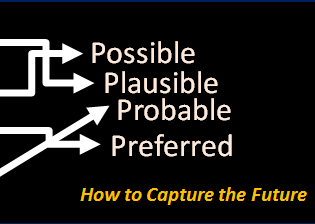
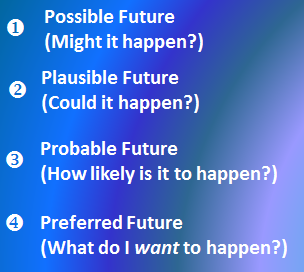
There are four broad categories of futures, the 4Ps: they are the possible, plausible, probable, and preferred futures. (There is a 5th P, potential futures, where the strategist applies unbounded imagination and extends the vision into realms that are best termed fantasy.) Ideally, we approach the 4Ps in the order suggested in the nearby graphic.

The strategist should begin with the possible future with the goal of developing a broad understanding of the situation.  Now is the time to consider “wild card” scenarios or “black swan” events. Divergent thinking (as opposed to convergent thinking) and an expeditionary mindset are appropriate styles of thinking.

  • Questions to Ask: What is the most radically-different unbounded future that I can imagine? What is the best and the worst case?  What is strange, weird, and crazy? Might it happen?
  • Answer to Expect:  Yes, the scenario might happen.

Next, she narrows into plausible future states (those which are “seemingly or apparently valid, likely, or acceptable; credible”). Convergent thinking is used.  An important idea for this is to consider the “narrative arc” of the organization or situation.

  • Questions to Ask: Which future states are feasible, given what we know at present? What would have to happen for this state to arise? How does this future state mesh with the founding mission of the organization and the values of the founders and other stakeholders? Could it happen?
  • Answer to Expect:  Yes, the scenario is plausible.

The third of the 4Ps is the probable future.  The strategic thinker is getting increasingly more analytical and applying systems thinking (being systematic in thinking is one of the four qualities of strategic thinking).  Here, she considers causal factors, delays, and weighting for the contribution of the causal factors to the emerging outcome.

  • Questions to Ask: Which events (that would cause this future) are is most likely?  What other events need to happen, too?  Where can we get data to support our assumptions? How likely is this future to happen?
  • Answer to Expect:  We have a systematic understanding of what would cause each scenario, and an estimate of the probabilities.

The fourth P is the preferred future state.  We can influence our future.  We can find the performance gaps and create strategic initiatives to close the gap.

  • Questions to Ask: What future do I prefer? What choices should I make about scope, objectives, and advantage? (See this article for more on those three elements.) What do I want to happen?
  • Answer to Expect:  This is the scenario that most fits my ambitions and expectations.

Cautions About the Preferred Future

The flow of attention described – possible to plausible to probable to preferred futures – is an ideal. It’s difficult to practice because it starts with imaginative and ambiguous scenarios.

It’s easier for people to start with stating a preferred future. However, that is problematic because the alternatives are feasible and occasionally do occur. You can’t be proactive if haven’t considered the future that you are pro-acting to.  As difficult as it may seem, the strategic thinker will consider alternative futures.

In those organizations that have established and mature process, people often hold unexamined assumptions is that the future will resemble the present. This is a status quo bias, and we see the results continually in firms that have been unable to respond to technology or social trends: film-based photography, newspapers, and bricks-and-mortar retailers of videocassettes to name just a few.

Aspirational visioning is common. Consider a large publically-traded company in agribusiness, a very mature business.  The CEO had seen a presentation on Red Ocean Blue Ocean strategy (The blue ocean is a new wide-open market where you don’t have to fight it out with competitors).  He challenged the Presidents of all of his business units to grow substantially in the next five years. People made some attempts to dream big ideas, but it the goal was soon forgotten as day-to-day operations reasserted their priority. Masked by the “great recession,” the company missed signals that its markets were fundamentally changing. The company ultimately shrank in size!

When managers move quickly to the preferred future, they often make the mistake of confusing the goal for a strategy. Note what UCLA’s Richard Rumelt says about this in his book, Good Strategy/Bad Strategy. He writes,

“Executives who complain about execution problems have usually confused strategy with goal setting. When the “strategy process is basically a game of setting performance goals – so much market share and so much profit, so many students graduating high schools, so many visitors to the museum – then there remains a yawning gap between these ambitions and action.  Strategy is about how an organization will move forward. Doing strategy is figuring out how to advance the organization’s interests. Of course, a leader can set goals and delegate to others the job of figuring out what to do. But that is not strategy. If that is how the organization runs, let’s skip the spin and be honest – call it goal setting.”

By examining the futures in the more rigorous way espoused here – possible, plausible, probable, and then preferred – the strategist increases the likelihood that they are considering real organizational issues that deserve attention and resources. Too, the act of generating alternatives increases the prospects of finding the insights that are necessary for a brilliant strategy.  As practical advice, consider increasing the amount of effort in strategic foresight, and then distributing your time in this way:

  • Possible Futures – 15%
  • Plausible and Probable Futures – 60%
  • Preferred Futures – 25%

You should iterate through versions of the plausible and probable futures.  You might want to occasionally relook the possible futures to see if they might be better categorized as plausible so as to avoid a blind spot.  Too, revisiting the possible futures might cause you to see a strategic driver in a new way.Strategic Thinking Definition

Remember that the definition of strategic thinking is not simply about imaging a future, it is doing with the intent of being better off in the future. Although this could be dismissed as “just a creative exercise,” it has the potential of sparking important creative insights necessary for building a good strategy.

How have you applied the 4Ps to your development of strategy?

How to Develop Strategic Insights

christopher columbus strategic thinker

Strategic thinking involves thinking about the future in a purposeful kind of way; that is, to generate useful insights that guide present-day choices. Presently, data analytics and statistical forecasting is popular, but I want to focus on generating insights, which usually come to the individual subconsciously.


Christopher Columbus: Strategic Thinker

Let’s imagine ourselves shadowing Christopher Columbus prior to 1492. As a naturally curious person, he gained knowledge for winds and currents and seamanship from his experiences sailing the Mediterranean, North Atlantic, and West Africa.  He read many books on astronomy, geography, and history and made hundreds of marginal notations in them. He  collected and interpreted data in the light of his personal ambitions.

History tell us little about Columbus’s reasoning. Regardless of the historical record, at some point in time Columbus developed the insight that he could use the Easterlies (trade winds off the coast of Africa that move from East to West) to sail westward, and then return to Europe via the Westerlies.

Christopher Columbus was a strategic thinker who took an abstract and unproven idea and proved it was true.

Andy Grove’s Strategic Decision

Consider Intel chairman Andy Grove’s story of how he came up with an important business strategy.  Attending a management seminar, Grove heard the story of how fledgling “mini-mills” in the steel industry began in the 1970s to offer a low-end product—inexpensive concrete-reinforcing bars known as rebar that subsequently gave them the entry to dominate the industry once dominated by integrated steel makers like U.S. Steel.  Grove saw that Intel was sitting in a similar situation: its dominance of its industry could be disrupted by allowing niche players in its industry to take the low-end part of the market.

“If we lose the low end today,” Grove realized, “we could lose the high end tomorrow.”  At Groves’ insistence, Intel redoubled its efforts to develop and market the low-end “Celeron processor” for the emerging personal computer market.

Openness to Fringe Data and Dissent

Grove had an abundance of data from Intel about its production, its production plans, market demand, and profitability of Intel’s various product lines. He and his team easily could have used that data to frame its strategic plans.  Indeed, that is very common for strategy setting by most firms.

Grove used analogy in his reasoning process: How is “A” like “B?” or “How are chips like steel?” One answer is that they are similar in that both have low-margin commodity-like grades and high-value engineered grades.

The insight is particularly remarkable in that Grove considered data from outside his industry.

Indeed, I meet many managers who say something like “Our industry is unique” when in reality there are more commonalities than differences. The statement, “we’re unique” establishes an excuse for close-mindedness and learning. They fall into a trap of where their belief system causes them to filter out contradictory information.

The openness to new ideas – from anywhere – reveals new explanations and possibilities.  Strategic thinking incorporates much of the characteristics of creative thinking; for example, both make considerable use analogies.

Strategic thinking is different because of its emphasis on the future and on success, particularly in the crafting of strategies that give the strategist an advantage over others.

Insights – Start With These Four Questions 

In my experience, insights come from posing and answering questions. 

When thinking about the future, it is useful to consider the answers to these four questions:

  • What data and evidence about the past, present, and future do I choose to consider (and to ignore)?
  • What seems to be happening?
  • What is really happening?
  • What might happen?

Strategists employ strategic thinking to generate about the future, but taking the context of the present and the past into consideration. How can you use strategic foresight to enhance your strategic thinking capability?

Could Strategy Be As Simple As This?

Strategic thinking is purposeful, and one purpose is to spark strategic insights. These insights make it easier to make decisions.

This article’s proposition is that strategy involves three choices by the strategist: choice of scope, choice of objective,  and choice of advantage. These choices do not constitute strategy, but answering them puts you on the course to actually having a strategy and not just a list of goals and initiatives.

What is the scope of our venture?

Scope is a term used to mean what is “in” and “out” of consideration. In other words, what is the definition of the venture? It could refer to the firm, the program, the team, or the individual.

The following sub-questions can help the strategist in partitioning and defining the scope of strategy:

  • Are we thinking big, or small?
  • Where is our geographic domain? Local, regional, expatriate, or global?
  • When we think about the venture as a “solution provider,” to what extent do we want to produce the solution, sell the solution, and service the solution? Stated differently, what part of the value chain do we want to operate in? Are there unexploited or under-exploited opportunities to capture value?
  • Is there anything that the venture explicitly won’t do?

What objective(s) do we choose to pursue?

The strategist first considers the circumstances – diagnosis – and selects an objective that best fits her diagnosis of the situation. Next, they choose an objective that is most sensible for the stakeholders.

The following sub-questions can help the strategist in identifying strategic objectives:

  • How do we think about success?
  • If we commit to a stretch goal, can we acquire the resources that will get us to the goal?

Critical thinking is a component of strategic thinking. Activate the logic to see if the objective is sensible.

For example, I once worked for a CEO said, “We grew revenues 35% last year, so our goal for next year is 35%.” That probably qualifies as a BHAG: a Big Hairy Audacious Goal.  BHAGs can be be useful if they are based on a logic and commitment to apply resources. They can be discouraging if there is no underlying design.

Who or what are we trying to gain advantage over?

Most people have heard this joke.

Strategic thinkers outrun the bearTwo campers come upon an angry bear. The first says, “I’m glad I wore my running shoes.” The second says, “you can’t outrun the bear.” The first says, “I don’t have to outrun the bear, I just have to outrun you.”

Sometimes it is only a small advantage that allows our success. But nevertheless, it is an advantage. Strategy is about leveraging a small advantage – and combining it with other advantages – so as to gain a more significant advantage.

Here are three sub-questions that help to identify the areas where the strategist can find advantage:

  • Who are the competitors and where is their focus and power?
  • What alternatives are available (including the “do nothing” alternative)?
  • Is the identified advantage actually important to the customer (or other important stakeholders)?

As it pursues its objectives, the venture needs to provide something of value to its stakeholders. There are always competitive alternatives and substitutes available to these stakeholders; for customers, its other product/service offerings; for                            not-for-profits, it is a competition for attention for funding or policy.

Conclusion

These three decisions do not comprise a complete definition of strategy, but they do provide a useful framing perspective. Insights are often simple ideas that tell us about the essence of something.

As you consider your answers, consider how you would blend them together into a problem-solving or opportunity-capturing design.

Do you agree that this is a simple way to think about strategy? How can a strategist apply the questions?

How to Improve Strategic Planning with Strategic Thinking (and vice versa)

Strategic thinking v planningStrategic thinking is an individual activity that is a style of thinking. It is not an organizational process or activity for the basic reason that people do not share the same brain.

Many writers use the phrase strategic planning to describe the organizational process of setting strategy. One style of strategic planning is adaptive, starting with scanning the external environment. For example, a firm may notice a trend in its customers or in government policy that opens new market opportunities.  The strategic planning process then moves into developing responses, and those responses often constitute the “strategy.”

Another style of strategic planning is a straight-forward planning exercise to achieve a pre-determined goal. Here the emphasis is more on the word plan, with the adjective “strategic” suggesting that it is an “important plan.”

Strategic thinking and strategic planning are similar in that:

  • Both deal with strategic intent and strategy
  • Both involve collecting and logically-processing information

Strategic planning receives much criticism. In many organizations, strategic planning has become highly structured; a groan-inducing set of templates that yield an artifact called the “strategic plan.” Often the reason for that is that strategy becomes tied to budgeting, and the words that comprise the “strategy”  becomes the documented rationale for the proposed budget. In too many organizations, strategic planning exists solely as an annually-repeating bureaucratic process of creating artifacts, discussing them, and filing things away.

This bureaucratic approach is further magnified by use of pre-structured templates. A common response to the templates is that practitioners skip the analysis by writing down the first thing that comes to their mind. Analysis is mentally exhausting and they are busy, and no one really notices what they write.

Yet, strategic planning is also supported and lauded. It certainly receives important resources.

Strategic planning can be done well or it can be done poorly.  Strategic thinking can be done well or it can be done poorly.  We don’t need to replace strategic planning with strategic thinking, we need to focus on the unique value adds of each.

I have a modest proposal: mix the advantages of strategic thinking
with the advantages of strategic planning to maximize the contributions of both.

~~~

How Strategic Thinking Improves Strategic Planning

Strategic thinking is the source of insights.  Insights are important design elements in strategy formulation. Consider how these insights are generated and applied:

  • Strategic thinkers imagine the “what ifs” and the future state. They contrast  the desired future with the current state. This information can is often captured (recorded) in strategic artifacts as situational analysis and vision statements.
  • Strategic thinkers often generate imaginative and creative problem solutions. The solutions would probably be recorded in the documents as strategies, or guiding policies.
  • Strategic thinking is opportunistic, and SWOT-type analysis includes capturing and recording opportunities.

How Strategic Planning Improves Strategic Thinking

Experience with strategic planning can foster an individual’s competence in strategic thinking. Participation in the process of strategic planning processes forces individuals out of their comfort zone into their learning zone. Here are a few of the benefits:

  • They learn to recognize and tolerate ambiguity and abstraction
  • They learn that while processes reduce ambiguity, processes the status quo; this anchoring on the status quo can cause the organization to be slow to respond to threats or opportunities
  • They learn that there is seldom one right practice or vision
  • The learn to ask better questions
  • They learn some of the specialized jargon, and can better communicate with others about concepts associated with strategy

I saw the value when I worked with volunteer leaders of a Project Management Institute (PMI) component group. PMI Headquarters required strategic plans and measures. These volunteer leaders were primarily trained in science or engineering and were accustomed to being provided a “scope” to which the would develop execution plans. They thought of planning as an exercise create documents that answered explicit questions.

Strategy is ambiguous and working with ambiguity put the people out of their comfort zone. They struggled (and complained) but they learned.

In the post-activity lessons learned, the participants felt that they had matured some as strategic thinkers. Here are a few representative comments:

  • “I learned to look for data, and not make assumptions when I had little data to support my hunch”
  • “I started to ask some of the same questions about my own organization’s strategic position”
  • “I became much more focused on our customers, and how we create value for them; If we can’t develop a good value proposition, we won’t succeed”
  • “I feel much more comfortable with the ambiguity that characterizes strategic situations”

Manage the Interface Between Strategic Thinking and Strategic Planning

Because organizations are social entities that must act collectively, individuals often (and should) share their information and insights with others. Here are some suggestions:

  • Encourage individuals to reflect and think strategically, with the purpose of developing relevant and meaningful insights.  Allocate time and encourage people to work individually, at least for a while. Strategic thinking is a somewhat solitary and reflective activity.
  • Discourage the sole reliance on formal written documents and templates.
  • Encourage people to have conversations where they share insights with each other.
  • Encourage people at all levels of the organization to participate in contributing to strategy.

Do you agree that strategic thinking and strategic planning are complementary?