Most students of strategy and strategic thinking will find their way to the work of Henry Mintzberg. From him, we gain an elegant statement that serves to powerfully focus our study of strategic thinking. He writes, “The real challenge in crafting strategy lies in detecting the subtle discontinuities that may undermine a business in the future. And for that,” he continues, “there is no technique, no program, just a sharp mind in touch with the situation.”[i] I have taken to calling the Mintzberg quote as the “sharpness theorem” and it is an effective introduction to strategic thinking.[1] It yields at least three notable principles:
A strategic thinker is “a sharp mind in touch with the situation.” Mental keenness is an essential characteristic of strategic thinking. The emphasis is on alertness for patterns and anomalies in the specific situation and not on universal methodology.
The ability to detect nuance is essential.
Detecting subtle discontinuities” is the “real challenge” of strategy. A discontinuity is a break in a trend. A discontinuity should cause your confidence in a prediction to significantly decline. In strategy work, a discontinuity is a difference in the environment that expresses itself over time. A common result is the disruption of the status quo.
A discontinuity transforms a linear phenomenon into non-linear. By contrast, linear thinking is a mindset that emphasizes understandability, predictability, and coherence. That becomes the criteria for whether something makes sense or not.
An ongoing task for the strategic thinker is noticing discontinuities and then proactively addressing emerging threats and the opportunities.
Good strategy is “crafted.” The word craft should suggest to you a design-oriented sensibility. It is a reasoning approach that emphasizes finding and capturing proprietary knowledge that is useful for creating strategy. Importantly, word craft connotes action.
Conventional thinkers tend to tell you that strategy is planned. The basis for any planning (and it is the limitation as well) is that the future can be predicted. The subtle mistake is that people confuse goals (what is wished for) for situational analysis (what is really happening).
Do you agree?
[1] This definition of theorem applies: an intelligible product of contemplation and something that can be proved.
[i] Henry Mintzberg, Crafting Strategy, Harvard Business Review, July 1987

 Strategic advantage comes from possessing a proprietary insight; it means that you know something valuable that others do not appreciate. These insights are “facts” that belongs to you and not to others. That proprietary insight gives you an advantage over your rivals.
 Forecasting and backcasting are common techniques for understanding the future. They have specific meanings. Forecasting is an extrapolation of current data into the future. When I identify a trend, I can choose to forecast that trend to continue. Back casting is the selection of a future scenario and then identifying the variables that would be needed to bring about that future scenario. An example: I wonder if a presently-strong company will fail in the future; I identify the premises and arguments that explain what would cause that failure.
 All students of strategic thinking occasionally feel just a little lost and frustrated. I imagine the topic of strategic thinking as a map – albeit a fuzzy and dynamic map – with salient landmarks that help you navigate through the subject. Even with the best of maps, you can find yourself wandering about when you’re in the field for the first time. Fortunately, with experience, the landmarks seem familiar and expected. The exploration seems more natural.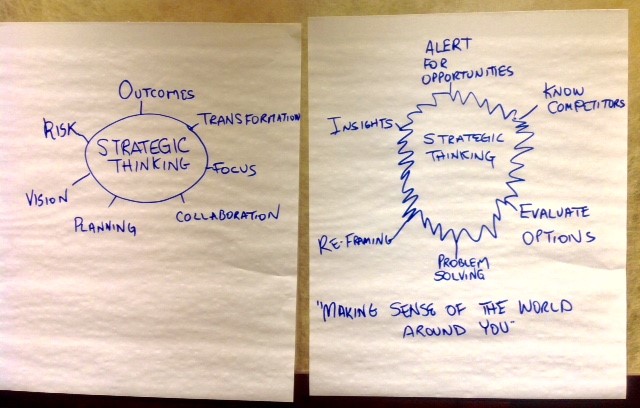


 Greg Githens, Executive & Leadership Coach